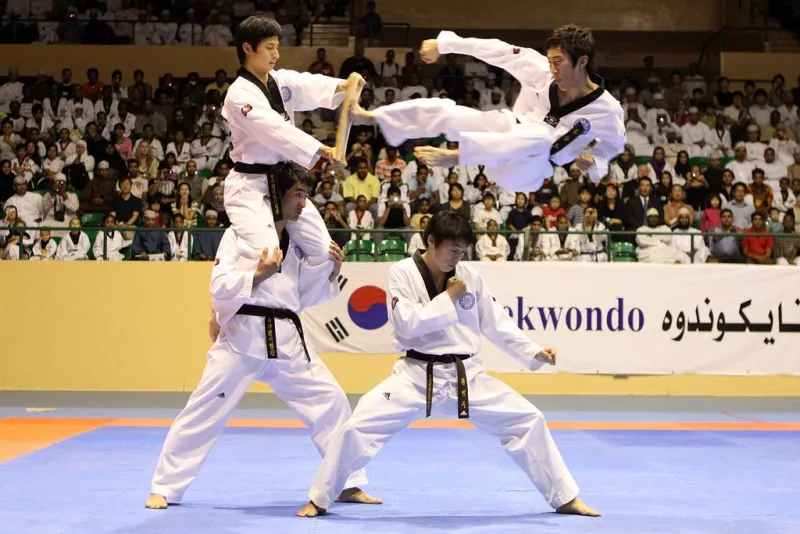
From Dorm Room to Dojang: Keeping Your ITF Training Alive Through Four Years of College

Photo: Ввласенко, CC BY-SA 3.0, via Wikimedia Commons
There's a specific week in August when a lot of promising teenage ITF athletes quietly stop training. They've moved into a dorm, the dojang is nine hundred miles behind them, and the first week of classes eats every hour they thought they'd have. By October, the uniform is at the bottom of a drawer.
It doesn't have to go that way — but it won't fix itself either. College doesn't reward momentum. It rewards systems. So here's the honest version of what the next four years can look like, including the parts nobody puts on a recruitment flyer.
The First Decision: Where You Train, Not Whether
Most college towns in the US offer three options, and none of them is perfect.
Option one: the campus club. Cheap or free, meets twice a week, run by students. Quality varies wildly — a club led by a third-dan junior is a gift, and a club that meets in a rec room and mostly drills cardio kicks is a different experience. Both beat not training.
Option two: a nearby commercial school. More structured, more expensive, and often a school that teaches World Taekwondo rather than ITF. That's fine, and we'll get to why in a second.
Option three: the commute. A 40-minute drive each way to an actual ITF dojang. Some athletes do it, and some of them thrive on it. Most burn out on it by sophomore year. Be honest with yourself about which one you are.
Visit all of them in your first three weeks. Not in October, when you're behind on everything.
ITF Versus WT Clubs: What Actually Transfers
If you walk into a World Taekwondo school, expect differences — and expect to be welcomed anyway. The two systems share a whole lot of DNA and a handful of real divergences:
- Forms are different. You'll be learning poomsae with different names and different rhythms rather than your tuls. The mechanics still reward clean lines and solid stances, but the sine wave won't be there, and instructors may ask you to smooth it out.
- Sparring is different. Hogus come on. Punches to the body score differently. The pacing is often a bit more continuous and less stop-start than ITF point exchange.
- Terminology and etiquette will be about eighty percent familiar and twenty percent confusing for a month.
None of that erases your training. What transfers is the thing you can't fake: years of balance work, hip rotation, and the ability to stay calm while someone tries to kick you. A good WT instructor will see that in one class. Be upfront about your background, be a beginner where you're a beginner, and don't spend the semester arguing rulebook trivia in the parking lot.
Ask These Questions Before You Sign Anything
Whether it's a club or a commercial school:
- How many training days per week, and what's the cancellation rate on those?
- Is there a competition track, or is this purely recreational?
- Who runs the sessions, and what's their rank and lineage?
- What does a semester cost, and is there a student rate?
- Can I drop in for two sessions before committing?
That last one catches more problems than the other four combined.
Maintenance Goals Beat Championship Goals
Here's the mental shift that keeps college athletes in the game. In high school, your goal might have been a medal at a specific tournament. In college, your goal is usually not losing ground.
Set a floor, not a ceiling. Three things, every week, no matter what:
- Two training sessions. One on campus, one anywhere. Even if one is forty minutes of patterns in a racquetball court at 11 p.m.
- One pattern, done slowly, on video. Ten minutes. Send it to your old instructor.
- One conditioning touch. Hip mobility, single-leg balance, or thirty minutes of anything that isn't sitting.
Three touchpoints a week is roughly six hours a month. That's enough to come home in December and still look like yourself in your tul. It is not enough to win nationals, and that's a trade you're allowed to make for a semester.
Virtual Check-Ins With Your Home Instructor
This is the single highest-return habit on the list, and almost nobody does it consistently.
Ask your instructor before you leave for school whether they'll do a monthly video call. Keep it to twenty minutes. Structure it: show one pattern, ask one technical question, report on your training, get one assignment for the month. If your instructor is comfortable with it, book it as a recurring calendar event — because you will absolutely skip it if it's a "whenever."
Some Orion's Belt athletes do this in a group session with two or three other students from their cohort. It's cheaper on everyone's time, and the social piece matters more than you think in month three of a semester.
Realistic Tournaments for a Packed Schedule
Let's talk competition, because "I'll just train for fun now" is usually a soft retirement in disguise.
Fall inter-club or collegiate events are the easiest on-ramp. Low cost, one day, usually within driving distance. If your college has any martial arts presence, there's likely a tournament within two hours in October or November.
Winter break is your real season. You'll be home for three to five weeks. That's when you train with your home school, get properly coached, and hit the biggest event of your year. Plan around it in September, not December.
Summer is the stretch. National and international events cluster in the summer for a reason — it's the only time the calendar opens up. If you're aiming at something serious, summer is where the aim belongs.
Skip the spring semester. Genuinely. March and April are a bad time to ask your body for a peak. Use spring to rebuild technique, not to chase a podium.
The Four-Year Shape of It
Freshman year is about landing somewhere. Sophomore year is about settling into a routine that survives midterms. Junior year, if you've kept the floor, is often the strongest year — your body is mature, your training is self-directed, and you've stopped needing someone to tell you to show up. Senior year is about handing something on, whether that's coaching a club, mentoring a freshman, or just leaving the school better than you found it.
The belt keeps moving as long as somebody keeps tying it. A semester in a rec room beats four years of intending to go back.